If you've ever had a sharp, electric jolt shoot down your leg out of nowhere, or a deep ache that starts in your low back and radiates all the way to your foot, you already know sciatica is no joke. It's one of the most misunderstood kinds of pain we treat here at Anchor Chiro, mostly because people assume it's just "bad back pain" when really, it's a nerve problem with its own set of quirks.
Let's talk about what's actually going on, and what we can do about it.
What is sciatica, really?
Sciatica isn't a diagnosis on its own, it's a symptom. It happens when the sciatic nerve, the longest nerve in your body, running from your low back through your hips and glutes and down each leg, gets irritated or compressed somewhere along its path. That irritation can come from a herniated disc, spinal stenosis, a tight piriformis muscle squeezing the nerve, or simple misalignment putting pressure where it shouldn't be.
The result is pain, numbness, tingling, or weakness that can show up anywhere from your low back to your toes. Some people feel it as a dull ache. Others describe it as a burning, shooting sensation that makes sitting through a work meeting or driving to Bridgewater feel like an Olympic event.
Why it tends to get worse before people ask for help
Sciatica has a sneaky habit of starting small. A little tightness here, an occasional twinge there. Then one day you bend over to grab a laundry basket or turn to check your blind spot in the car, and it feels like your leg gave out. By the time most people come see us, they've usually been quietly managing it for weeks or months, hoping it would resolve on its own.
Here's the thing: the longer a nerve stays irritated, the more your body compensates around it, tightening up other muscles, shifting how you walk, guarding your movement without even realizing it. That compensation pattern can end up causing its own set of problems. Catching it earlier almost always means a faster, simpler path back to feeling like yourself.
How we approach sciatica at Anchor Chiro
There's no single "sciatica adjustment" that fixes everyone, because sciatica has different root causes depending on the person. That's why we start with a real assessment, not a five-minute once-over, to figure out exactly where the compression or irritation is coming from before we touch anything.
From there, treatment might include:
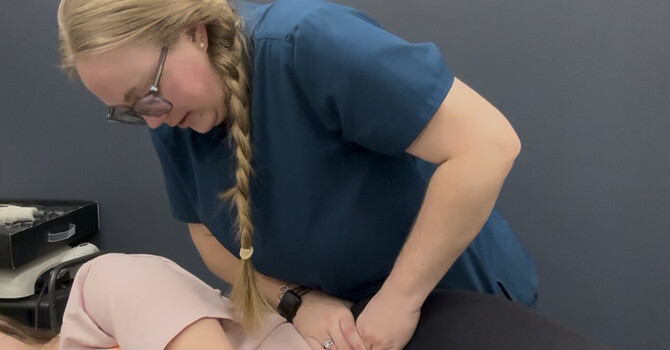
Gentle, targeted spinal adjustments to reduce pressure on the nerve root and restore normal joint movement in the low back and pelvis. Active Release Technique (ART), since a tight piriformis or hip rotator is often part of the picture, and ART is one of the most effective tools we have for releasing that kind of deep muscular tension around the nerve. Kinetisense motion assessment, which lets us actually see how your spine and hips are moving (or not moving) and track your progress objectively over time, rather than just guessing whether things are improving. Guidance on positions, movements, and daily habits to avoid aggravating the nerve while it calms down, because what helps sciatica is often the opposite of what feels intuitive.
Most patients are surprised at how quickly things can shift once we identify the actual source of the irritation instead of just chasing the pain around.
When to stop waiting it out
A little stiffness after a long car ride is normal. Pain that shoots below the knee, numbness that doesn't let up, or weakness in your foot or leg is your body telling you something needs attention. The sooner we look at it, the more options we usually have.
If you're in Bridgewater, Somerville, or anywhere else around Somerset County and that familiar ache down your leg has started showing up more often than you'd like, let's figure out what's actually causing it. Give Anchor Chiro a call or book online, and let's get you moving without wincing again.

Kate Denker
Contact Me